Hey there, thanks for swinging by—today I’m breaking down a question I get at least a dozen times a week as a nitrogen generator supplier: “What’s the actual noise level of a nitrogen generator?” Nitrogen Generator
If you’ve ever worked in a plant, a lab, or a manufacturing floor, you know noise isn’t just an annoyance—it’s a OSHA liability, it messes with team focus, and sometimes it’s a dealbreaker for placing gear near office spaces or loading docks. A lot of folks online spout generic decibel numbers like “60 to 85 dB” without context, so let’s cut the fluff and get real, especially since we build these systems (not just resell them) and test every unit before it ships.
First, let’s start with a quick decibel 101 to make sure we’re all on the same page—no textbooks, I promise. Decibels (dB) measure sound intensity, and it’s a log scale, which means every 10 dB jump is actually double the perceived volume. So a 70 dB sound doesn’t sound twice as loud as 60 dB—it’s ten times more intense. That’s why a vacuum at 50 dB is quiet, a dishwasher at 70 dB is noticeable, and a lawnmower at 90 dB will make you reach for earplugs. Now, nitrogen generators don’t have one universal noise level—this is where things get specific, based on what type of system you’re dealing with, because that’s the biggest factor.
Most nitrogen generators fall into two main categories for industrial use: membrane nitrogen generators and PSA (Pressure Swing Adsorption) nitrogen generators. Let’s break each down, since that’s the split I see customers arguing over all the time.
Membrane units are the smaller, simpler ones—you’ll find these in labs, small manufacturing lines, or even food packaging setups where you only need a low-to-medium nitrogen flow (usually up to 50 SCFM, for those in the know). How do they work? They push compressed air through a bundle of hollow fiber membranes, and the smaller oxygen, water, and CO2 molecules slip through the membrane walls, leaving nitrogen behind. No moving parts except a small internal blower to feed the air—this is why they’re so quiet. From our testing, a standard 20 SCFM membrane unit runs at 52 to 58 dB at 1 meter away. What’s that equivalent to? A quiet conversation in a coffee shop, or a fridge running in the next room. You can actually stand right next to it and have a normal chat without raising your voice. The bigger membrane units (say 100 SCFM) crank up a little to 60 to 65 dB, which is like background music at a low volume—still no earplugs needed.
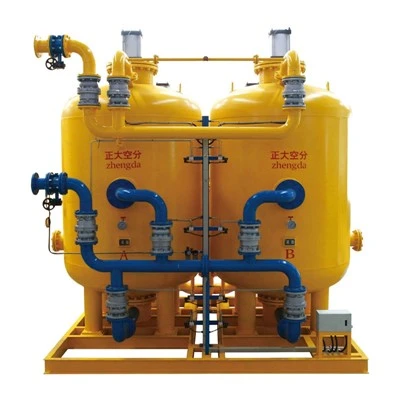
Now PSA units are the heavy hitters—these are for large manufacturing, oil and gas, or automotive shops where you need high flow (50 SCFM up to 10,000 SCFM or more) and high purity nitrogen. How do they work? They use two canisters filled with carbon molecular sieves (CMS) that trap oxygen, water, and other gases, then switch between the two canisters to regenerate—no downtime, constant flow. The catch here: PSA systems have a few more moving parts than membrane units, including larger compressors, a blower for regeneration, and solenoid valves that click. So their noise level is higher, but it’s still manageable. A mid-sized PSA unit (500 SCFM) runs at 72 to 78 dB at 1 meter. What’s that? A busy office environment, or a vacuum running inside a house. You’ll need a slight raise in your voice to talk to someone 3 feet away, but no ear protection for most people. The big industrial PSA units (10,000 SCFM) top out around 82 to 85 dB. That’s like a heavy dishwasher or a laundry machine running—this is where you might want basic earplugs if you’re working next to it all day, but it’s still way quieter than a lawnmower or a power saw (which is 90+ dB, just for context).
Wait a second—why do some other suppliers advertise way lower numbers? 50 dB for a 500 SCFM PSA unit? That doesn’t add up, trust me. That’s a marketing trick—they’re probably quoting the noise level inside the enclosure, not at 1 meter away, or testing it in a soundproof lab, not an actual warehouse where there are reflective walls bouncing sound around. And let’s be real: if you’re placing a nitrogen generator in a plant that’s already 80 dB from other machinery, a 78 dB unit won’t make the total noise level jump that much—sound adds, but log scale means 78 + 80 is only like 83 dB total, not 158 dB or something.
Also, there’s a huge variable almost no one talks about: where you place the unit, and what kind of enclosure it’s in. We build all our standard units with acoustic enclosures as a default, but if a customer needs it extra quiet, we offer an upgrade with 2-inch thick acoustic foam and sealed seams that can knock 5 to 10 dB off the noise level. That’s a game-changer. For example, that 75 dB PSA unit can drop to 67 to 70 dB with the upgraded enclosure—quiet enough to place right next to a production line or even a small office nook if your team doesn’t want a separate equipment room. On the flip side, if you have a big open warehouse with concrete walls, that noise will bounce a lot more than if it’s in a small, dry wall utility room. We always tell customers to tell us where the unit is going—if it’s near employee workstations, we’ll suggest the extra acoustic package, no extra hassle.
Another thing to watch out for: misinformation online will tell you “all nitrogen generators are 80+ dB.” That’s just not true. We have a customer who runs a 25 SCFM membrane unit right next to their lab bench where they do quality control testing—their engineers never mention noise as a distraction, and that unit is 55 dB, same as their lab’s air conditioning unit. Conversely, I’ve had a customer who works in a auto body shop try to put a 3,000 SCFM PSA unit right next to their paint booth, and they ended up needing to add a separate concrete block wall around the unit to keep the noise from disrupting their paint mixers. That’s a real example—we didn’t sell him the wrong unit, we just helped him adjust placement and add an extra enclosure to fix the problem.
Why does this matter to you, beyond just not annoying your team? OSHA’s action limit for noise exposure is 85 dB over an 8-hour workday. So that big industrial unit at 85 dB is right at the limit—if your employees are working within 1 meter of it for 8 hours straight, you need to provide ear protection. But most of our customers place their units at least 3 meters from their main work areas, so that 85 dB unit drops to like 75 dB at 3 meters, which is well under OSHA’s limit. That’s a big detail people miss when they’re looking at decibel numbers—distance is your friend. Every time you double the distance from a sound source, the noise level drops by about 6 dB. So at 1 meter, 78 dB; at 2 meters, 72 dB; at 4 meters, 66 dB. That’s why a 82 dB unit across the warehouse is barely noticeable over the other machinery.
Let’s wrap this up with a quick recap so you don’t have to memorize all the numbers:
- Small membrane units (under 50 SCFM): 52 to 65 dB at 1m = quiet coffee shop to low office
- Mid PSA units (50-1,000 SCFM): 70 to 78 dB at 1m = busy office to vacuum cleaner
- Large industrial PSA units (over 1,000 SCFM): 78 to 85 dB at 1m = heavy dishwasher, earplugs optional most days
- Add acoustic enclosure: drop 5 to 10 dB, perfect for near work areas
- Double distance: drop 6 dB, place units a few feet away from workstations and you’re golden
I get it—noise level isn’t the first thing you think about when you’re shopping for a nitrogen generator. You’re worried about purity, flow, cost, reliability. But if you’re placing the unit near your team, or in a space where extra noise will mess with operations, it’s a critical detail. We don’t cut corners on acoustic design here—every unit we build gets tested with a professional decibel meter right before it ships, so we can give you an accurate number, not a marketing pitch.

If you’re shopping around and someone gives you a 1-sentence answer on noise level, ask them for specifics: what type of unit, measurement distance, whether it’s tested in real-world conditions, and if an acoustic enclosure is an option. A lot of times, that generic number is wrong, and it’ll lead to headaches down the line when your new generator is too loud to use where you need it.
Vacuum Pump If you’re not sure which unit is right for your space, or you want to talk through noise options for your setup, hit us up. We’ll walk you through different models, how their noise levels work in your specific environment, and even send you test data from our warehouse. No pressure, just straight talk—we’ve been in this long enough to know that a good nitrogen generator isn’t just about flow or purity, it’s about working for your whole team, not just your bottom line.
References
- Occupational Safety and Health Administration (OSHA). Noise Control in Manufacturing Facilities. 2022.
- Compressed Gas Association (CGA). Industrial Nitrogen Generator Performance Specifications. 2021.
- Membrane Technology and Research, Inc. Hollow Fiber Membrane System Noise Emission Tests. 2020.
- Pressure Swing Adsorption (PSA) Technology Association. Industrial PSA Generator Acoustic Testing Data. 2021.
Jiangxi Fuze Power Equipment Co., Ltd.
With abundant experience, we are one of the most professional nitrogen generator manufacturers and suppliers in China. Please feel free to buy customized nitrogen generator made in China here from our factory. For quotation, contact us now.
Address: 1st Floor, Factory Building No. 2, Optical Base, Shangrao Economic Development Zone, Jiangxi Province
E-mail: fuzedongli@163.com
WebSite: https://www.jxfzpower.com/
